Why Your Outbound Isn't Working: The 6-Point Diagnostic We Run for Every New Client
The exact audit framework we run when a company tells us their cold email is broken. Six root causes, in priority order.
TL;DR
- Outbound failures trace to one of six root causes. This is the exact diagnostic we run, in order.
- There's a dependency chain: deliverability before targeting, targeting before copy. Fix out of order and you're optimizing a broken foundation.
- Cold email bodies stay in the 50-90 word range. Situation-based openers beat generic product pitches.
- Small send volumes mislead. A handful of replies can swing your rate by a point either way, don't draw conclusions too early.
- Use this as a self-audit first. If two or more checks fail, or capacity is the bottleneck, book a strategy call and we run the same six points with you.
The client who tells us their outbound is broken almost always means their copy is broken, and almost always they are wrong. We do not open the copy doc first. Six root causes account for nearly every dead campaign we have diagnosed, and they sit in a dependency chain: deliverability breaks targeting's signal, targeting breaks copy's signal, and copy is the one everyone wants to fix first because it is the only piece they can see. Fix out of order and you are optimizing a foundation that is still broken underneath.
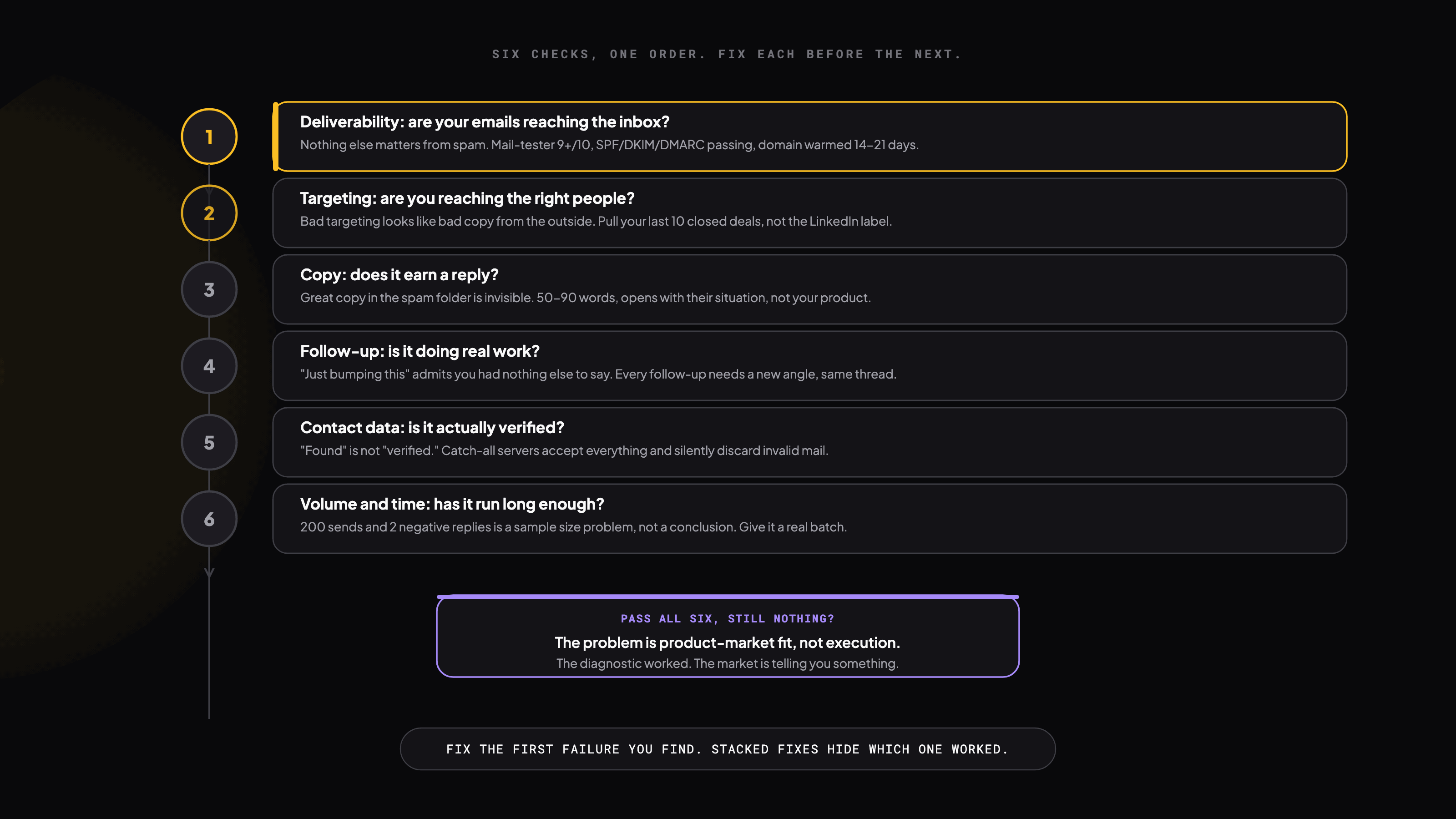
| # | Check | Pass signal | Fail signal |
|---|---|---|---|
| 1 | Deliverability | Mail-tester 9+/10; SPF/DKIM/DMARC pass; warmed domain | Spam folder, score under 7, sudden bounce spike |
| 2 | Targeting | ICP matches closed-won deals; decision makers, not titles alone | Silence from the right inboxes; wrong company stage |
| 3 | Copy | 50-90 words; opener names their situation; low-commitment CTA | High opens, near-zero replies; product pitch in line one |
| 4 | Follow-up | New angle each touch; same thread | Just bumping this; new threads with no new reason |
| 5 | Contact quality | Mailbox verified deliverable; employment current | Catch-all accepted as verified; stale titles |
| 6 | Volume and time | Enough sends and weeks to trust the rate | 200 emails, two replies, and a conclusion |
How to use this
- Work the list in order. Do not skip to copy because it feels most actionable.
- Fix the first failure you find before moving to the next diagnostic.
- Pass all six and still get no replies: the problem is product-market fit, not execution.
1. Are your emails reaching the inbox?
Nothing else matters if your emails land in spam. We start every audit here.
Quick deliverability checklist
- Mail-tester.com score: 9+/10. Below 7 is a configuration problem.
- SPF, DKIM, and DMARC all configured and passing.
- Sending volume kept well under 30 emails per mailbox per day, ramped up gradually rather than starting there.
- Domain warmed for at least 14-21 days before cold sending begins.
- No shared sending infrastructure with unknown senders.
2. Are you reaching the right people?
Emails land, nobody replies. Bad targeting looks like bad copy from the outside; the symptom is the same silence. Pull your last 10 closed deals: company size, growth stage, tech stack, hiring velocity. Not the industry label on LinkedIn.
✗ Don't do this
VP of Engineering at any tech company with 50+ employees
✓ Do this instead
VP of Engineering at Series B SaaS companies hiring 3+ backend engineers, on AWS, 50-200 employees, no dedicated DevOps team
Check whether you are reaching decision makers or gatekeepers: a Director of IT at 50 people decides; the same title at 5,000 people submits a request to procurement.
Re-verify current employment on any list that has been sitting for more than a few months. LinkedIn titles go stale faster than people expect, and a sourced-then-stale contact wastes a send whether or not the email itself bounces.
3. Does your copy earn a reply?
Third for a reason: great copy in the spam folder is invisible, and great copy to the wrong prospects gets politely ignored. If you passed 1 and 2, copy is often the unlock. We keep cold email bodies to 50-90 words.
✗ Don't do this
I'm reaching out because we help companies like yours streamline their sales process with our AI-powered platform that integrates with your existing CRM to provide real-time insights.
✓ Do this instead
Saw that Acme just opened a second sales office in Austin. Most teams scaling that fast find their existing outbound process breaks around 5 reps.
Open with the prospect's situation, not your product. "I'm reaching out because..." tells them nothing they don't already know: someone is reaching out. Naming something specific and true about their situation is what earns the next sentence.
CTA: "Book a 15-minute demo" is a demand from a stranger. A specific, low-commitment question is an invitation, and it's what we default to across our own campaigns.
Copy checklist
- 50-90 words
- Opening line names their situation, not your product
- No company name in the first sentence
- CTA is a specific, low-commitment question, not a calendar link
- One hyperlink max, zero is better
4. Is your follow-up doing real work?
"Just bumping this" is not a follow-up, it is an admission you had nothing else to say. Every follow-up needs a new angle, a data point, a case study, or a trigger event. Keep follow-ups on the same thread rather than opening a new one: it inherits context the prospect would otherwise have to reconstruct.
| Follow-up pattern | What happens |
|---|---|
| "Just following up" | Prospect feels pestered. No new reason to reply. |
| New angle on the same problem | May resonate where email 1 did not. |
| Relevant case study or data point | Shifts from "who is this" to "they know something." |
| Timely trigger (funding, hire, news) | Feels personal even at scale. |
5. Is your contact data actually verified?
Bad data does not just bounce, it degrades domain reputation. "Found" is not "verified." Catch-all servers accept everything, including invalid addresses, and silently discard the email. Verification has to confirm the specific mailbox is real, not just that the domain exists.
Contact verification checklist
- Confirmed deliverable status from a real verification pass, not just "valid" or "found"
- Catch-all domains flagged and handled with extra scrutiny
- Employment verification: confirm they still work there
- Email domain matches the company domain
- Bounce rate monitored per campaign, per day; a spike triggers an immediate pause
6. Have you given it enough volume and time?
Founders send 200 emails, get 2 negative replies, and conclude cold email does not work. That is a sample size problem, not a conclusion. A single reply swings your rate by a meaningful amount when the denominator is small, and it takes a real batch of sends before a pattern is trustworthy.
Timeline matters too: someone reads Monday, thinks Wednesday, replies Thursday. A campaign launched last week is not done for another 2-3 weeks. If you have sent a real volume with confirmed deliverability, targeted ICP, and multiple copy variants and still get close to nothing, the issue is probably product-market fit or pricing, not execution.
When to stop fixing it yourself
Passing all six and still hearing nothing back is a different problem than failing one of them, and it is the one people least want to hear: the diagnostic worked, the system is not broken, the market is telling you something about the offer. That does not automatically mean hire an agency; it might mean a one-time outside audit to confirm what your own read already suspects. Bring in help when the diagnostic instead reveals a capacity problem, because outbound run well is a daily discipline, not something that survives being a side project.
What a facilitated diagnostic looks like
On a strategy call we walk the same six points against your live stack: DNS and sending platform, recent reply samples, ICP definition versus closed-won deals, list verification method, and send volume over the last 30 days. You leave with a priority-ordered fix list, not a pitch deck. If the gaps are systems and capacity rather than a single copy tweak, we map whether fractional GTM engineering belongs in the plan. Related reading: the cold email framework and email deliverability infrastructure playbooks, plus client results in case studies.
Bring these if you book the call
- Access notes for your sequencer and DNS (or screenshots of SPF/DKIM/DMARC and a recent mail-tester score)
- Last 20 replies, positive and negative
- Your current ICP definition and a sample of 50 recent sends
- Bounce rate and reply rate for the last two campaigns
Get the runnable version
Enter your email and we'll send you this playbook, plus the open GitHub repo of setup skills when it ships.
Want this built for your team?
We build and run these systems embedded with your team.