How to Build an Agentic GTM System
Four layers, data through routing, each one gating the next. A human researching accounts one at a time cannot compound; a pipeline can.
TL;DR
- Four layers, each gating the next: data, research, copy, routing. A contact does not reach a rep's inbox without clearing all four.
- A human researching accounts one at a time is bounded by hours in the day. An agent pipeline runs the same steps in parallel and does not degrade under volume.
- Build order matters more than speed: data and research first, copy second, routing last, QA before anything sends.
- Routing is a decision table, not a gate you eyeball: score, verification status, and CRM state each route to a specific outcome, never a maybe.
An agentic GTM system replaces the SDR who researches one account, writes one email, and repeats, with a pipeline of agents that each do one job: enrich, research, write, route. The reason it beats the manual version isn't speed, it's that a human bounded by hours in the day degrades under volume while a pipeline runs the same steps at account 5,000 that it ran at account one.
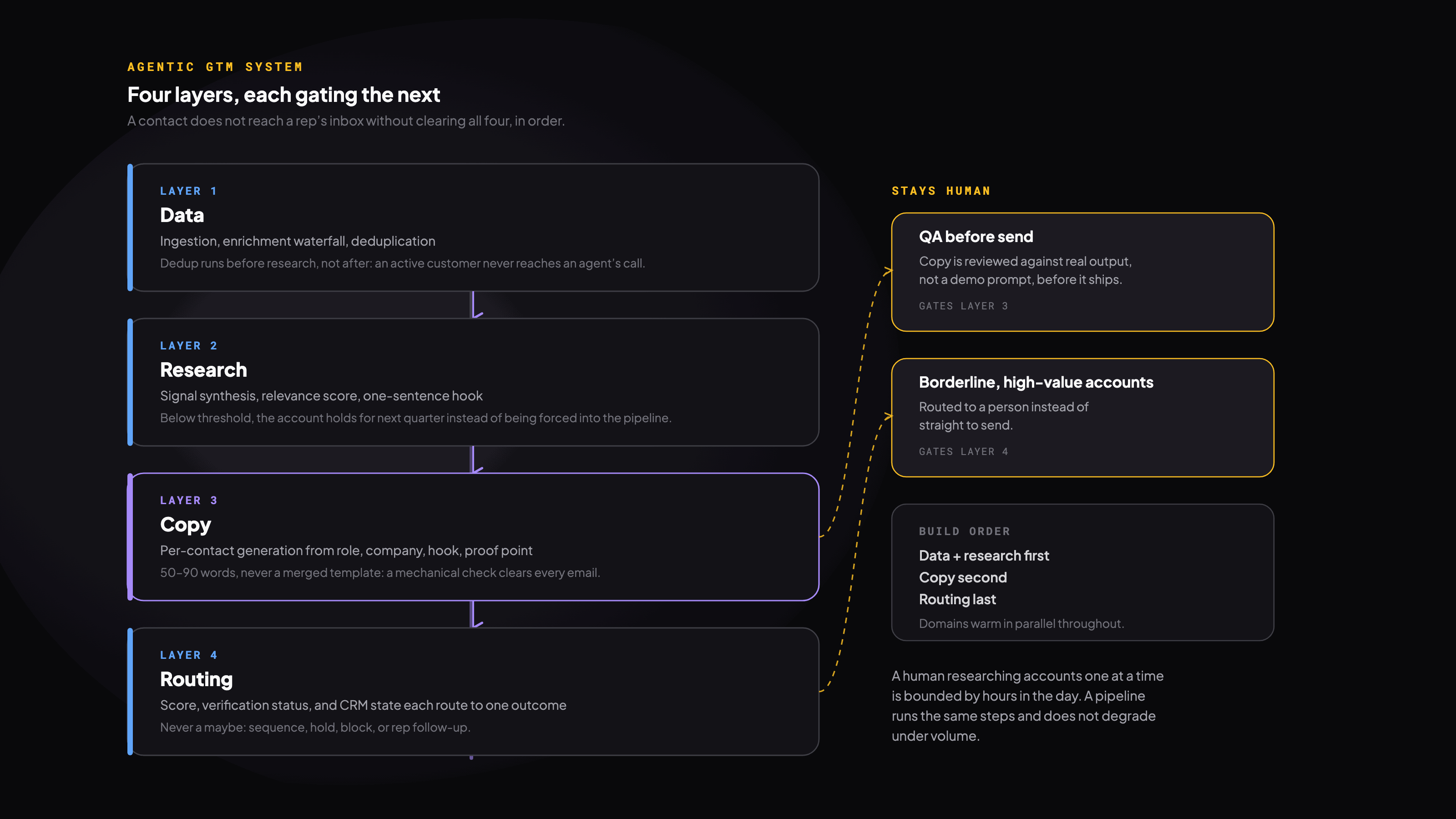
The Four Layers
- 01Data: account and contact ingestion, enrichment, deduplication
- 02Research: AI-powered account intelligence, signal detection, scoring
- 03Copy: personalized email generation using LLMs
- 04Routing: qualification logic, rep assignment, sequencer enrollment
Each layer gates the next. A contact does not reach a rep's inbox, or a sequencer, without clearing all four in order.
Data and Research
- Ingestion: manual lists, hiring/funding/tech signals, CRM exports, intent data, event triggers.
- Enrichment: a waterfall of providers queried in sequence, each filling gaps the last missed. One provider alone always leaves gaps.
- Deduplication before research, not after. Any contact already in the CRM is filtered out before an agent spends a call researching them.
- Research: Claude synthesizes business model and pain signals into structured output, JSON with a relevance score, a hook, and a one-sentence summary. Below threshold, the account holds for re-evaluation next quarter instead of getting forced into the pipeline.
Copy and Routing
Copy is generated per contact from role, company, hook, and one proof point, inside the 50-90 word constraint, never a merged template. Every email clears a mechanical check before sending; high-value accounts route to human review instead of straight to send.
| Condition | Action |
|---|---|
| Score above threshold, email verified | Enroll in email sequence |
| Score borderline, high-value account | Route to human review |
| Score below threshold | Hold for re-evaluation next quarter |
| Existing CRM contact | Flag for rep follow-up, skip outbound |
| Previous bounce or unsubscribe | Block permanently |
Replies route through a classification agent: interested goes to the assigned rep with context attached, not-interested triggers an automatic unsubscribe. No reply sits waiting on someone to notice it.
The Stack
| Layer | Tool | Role |
|---|---|---|
| Data | Clay + BounceBan/ZeroBounce | Enrichment, scoring, verification |
| Research | Claude + Exa | Account synthesis, web research |
| Copy | Claude | Email copy generation |
| Routing | EmailBison/SmartLead/Instantly + HubSpot/Salesforce | Sequencer enrollment, CRM logging |
Build data and research first, copy second, routing last, with QA before anything sends. Domains can warm in parallel the whole time; nothing sends until copy has been reviewed against real output, not a demo prompt.
Where This Breaks
- Skipping email verification. Bounces damage sender reputation permanently, not just for the campaign that caused them.
- No deduplication before research. Emailing an active customer isn't a technical bug, it's a relationship risk.
- Treating the prompt as an afterthought. Copy quality depends entirely on it; a generic prompt produces generic copy no matter how good the underlying research is.
- Building all four layers at once instead of data and research first. A routing layer with nothing solid feeding it just routes garbage faster.
Get the runnable version
Enter your email and we'll send you this playbook, plus the open GitHub repo of setup skills when it ships.
Want this built for your team?
We build and run these systems embedded with your team.