The Cold Email Framework: First Email, Sequence, Follow-Ups
50-90 words, one real signal, one low-friction ask, four steps over two weeks. The complete framework, not just the opener.
TL;DR
- First email: 50-90 words, one real signal, one low-friction ask. Longer emails get deleted before they're read.
- Sequence: 4 steps over 14 days (Day 1, 4, 7, 14), thread replies from Step 2 on, a new angle every step.
- Most replies come from Step 2 or 3, not Step 1. Stopping after the first email abandons most of the pipeline.
- Every follow-up must add new value, a new angle, proof, or framing. 'Just checking in' is noise, not a follow-up.
Most cold email fails before it's read: opening with 'I' or 'We', pitching three features in 150 words, asking for a 30-minute call up front, then stopping after one email when the reply never comes. The fix isn't a better template. It's a first email built on real research, a sequence that presents the value from different angles, and follow-ups that earn the second look instead of just bumping the thread.
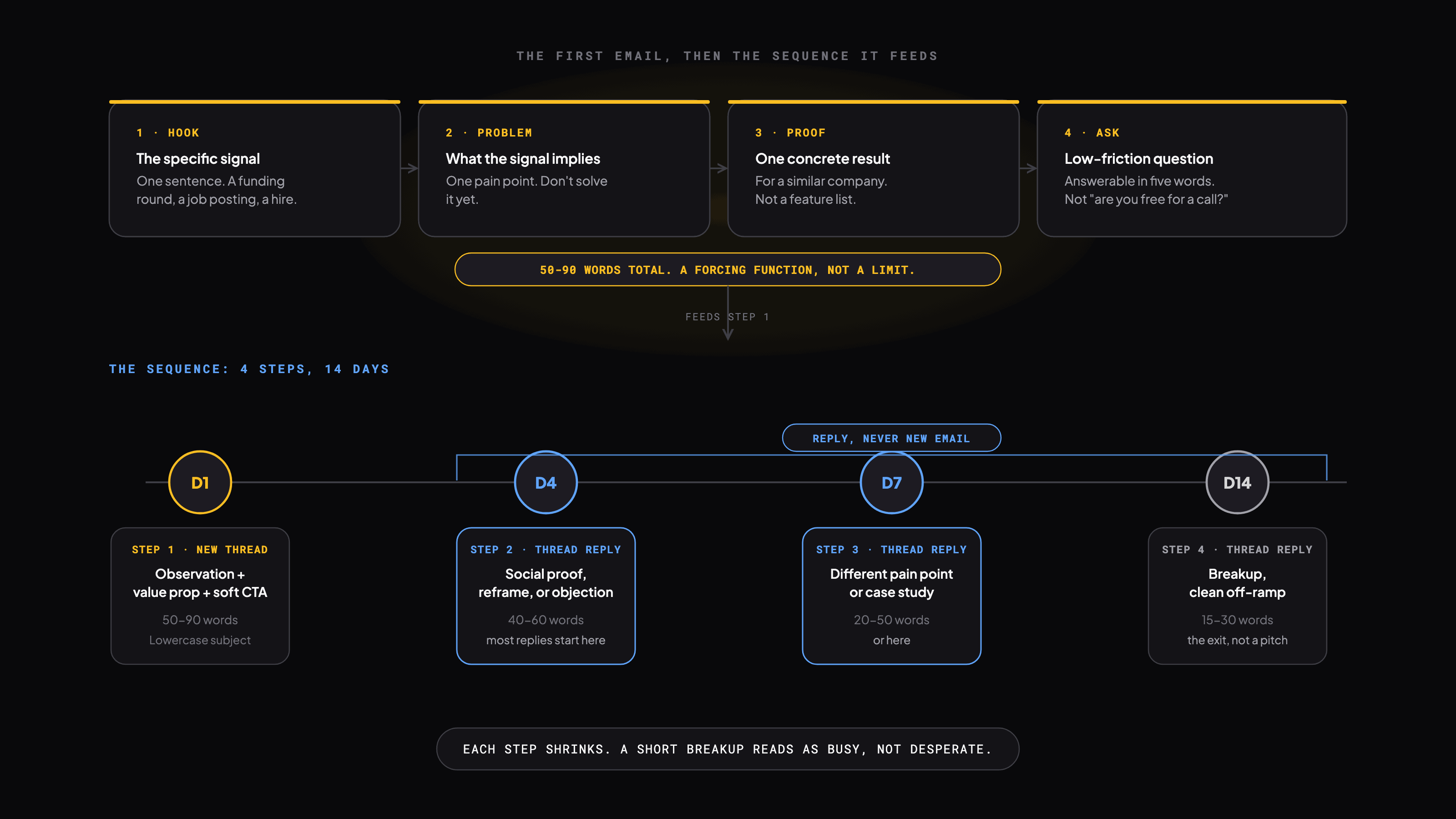
The First Email: 50-90 Words, 4 Parts
50-90 words is a forcing function, not a magic number. At 200 words you hedge and bury the ask. At 70, every sentence earns its place. Personalization isn't a first name, it's one real signal: a funding round, a job posting, their tech stack, a leadership hire. We pull this at scale with AI agents.
- 01Hook: the specific signal you found, one sentence.
- 02Problem: one pain point that signal implies. Don't solve it yet.
- 03Proof: one concrete result for a similar company.
- 04Ask: one low-friction question, answerable in five words, not 'are you free for a call?'
✗ Don't do this
Hi [First Name], I hope this finds you well. We are a leading provider of outbound solutions that help B2B companies scale pipeline. Our platform has helped clients increase meeting rates by up to 300%. I'd love to schedule a 30-minute call. Are you available this week?
✓ Do this instead
Saw you're hiring three SDRs in Q2, usually signals the outbound motion needs support before headcount arrives. Worth a quick conversation about what the first 90 days should look like?
Subject line: short and specific beats clever. Lowercase reads as a real person, not a campaign. Skip 'free' and 'guarantee', both are spam-filter bait and they signal template before the prospect opens it.
The Sequence: 4 Steps, 14 Days
| Step | Day | Angle | Words | Subject line |
|---|---|---|---|---|
| Step 1 | Day 1 | Observation + value prop + soft CTA | 50-90 | New subject, lowercase |
| Step 2 | Day 4 | Social proof, reframe, or objection | 40-60 | Re: original, thread reply |
| Step 3 | Day 7 | Different pain point or case study | 20-50 | Re: original, thread reply |
| Step 4 | Day 14 | Breakup, clean off-ramp | 15-30 | Re: original, thread reply |
Length shrinks step to step, 50-90 words down to 15-30 by the breakup, and that shrinkage is itself a signal: a short email at Step 4 reads as someone with better things to do, which is the point. From Step 2 on, reply in the same thread rather than sending new emails. The recipient sees prior context without re-reading your pitch, and thread replies get better inbox placement than new cold threads because the thread already carries engagement signals. Set Step 2 onward to 'reply to previous step' in your sending platform, not 'send as new email.'
Follow-Ups: The Only Rule That Matters
Every follow-up must add new value, a new angle, proof point, framing, or piece of context, never the same message with a different opener. Most replies come from Step 2 or 3, not Step 1. Stopping after the first email is walking away from most of the pipeline.
- Step 2 (Day 4): reframe the value prop, add one named data point, or address a common objection directly. Never 'just following up.'
- Step 3 (Day 7): switch the pain point entirely, speed to cost, cost to risk, and reference something timely, a job posting or recent news.
- Step 4 (Day 14): no new information. It's an exit, not another pitch. Give permission to say no, or ask 'should I close your file?' Length itself is the signal here.
| Never write this | Why it fails |
|---|---|
| "Just bumping this to the top of your inbox" | Admits you have nothing new to say |
| "Wanted to follow up on my last email" | Says nothing; every follow-up is a follow-up |
| "Just checking in!" | Demands their time, offers nothing |
| "As per my previous email..." | Passive-aggressive |
✗ Don't do this
Hi John, Just wanted to follow up on my last email and see if you had a chance to review. We'd love to connect and share how we can help your team. Let me know if you're interested! Best, Sarah
✓ Do this instead
John, a freight broker we work with just cut their quote-to-close time by 40% after automating carrier outreach. Thought that might be relevant given what you're building at [Company]. Worth a quick call? Sarah
How Do You A/B Test It?
| Variable | What to test | Metric to watch |
|---|---|---|
| Subject line | Question vs. statement | Reply rate |
| Step 1 hook | Hiring vs. news vs. product signal | Reply rate |
| Step 1 length | 50 words vs. 80 words | Reply rate |
| Step 2 angle | Social proof vs. objection handling vs. reframe | Reply rate |
One variable at a time, minimum 100 sends per variant before drawing conclusions. Don't test Steps 3-4 until Steps 1-2 are optimized, the sample sizes are too small to mean anything. Opens aren't a reliable read at any step: Apple Mail Privacy Protection and security scanners inflate them regardless of what actually happened.
What Should You Do First?
- 01Pick one ICP segment: one title, one company type, one pain point.
- 02Research a handful of accounts manually before using any automation, enough to know what a real signal looks like for this ICP.
- 03Write the 4-step sequence, Step 1 under 90 words, shrinking through the breakup.
- 04Don't scale until one variant has a meaningful positive reply rate.
Get the runnable version
Enter your email and we'll send you this playbook, plus the open GitHub repo of setup skills when it ships.
Want this built for your team?
We build and run these systems embedded with your team.