What Is GTM Engineering?
What GTM engineers build, how the role differs from RevOps, what it costs, and when fractional makes more sense.
TL;DR
- A GTM engineer builds the automated systems that used to be manual SDR work: research, enrichment, personalization, campaign execution.
- 'One GTM engineer replaces 5 SDRs' is context-dependent: it works when the ICP is narrow and well-signaled, and it doesn't when the sale needs early human judgment.
- Hire in-house when outbound is a core long-term channel. Hire fractional when you need results before you can hire, or the backlog is broader than one person covers.
A GTM engineer is a technical operator who builds and maintains the systems that power outbound: data pipelines, enrichment waterfalls, AI-driven research, copy generation, campaign infrastructure. Instead of prospecting manually, they write the code and configure the tools that do it at scale.
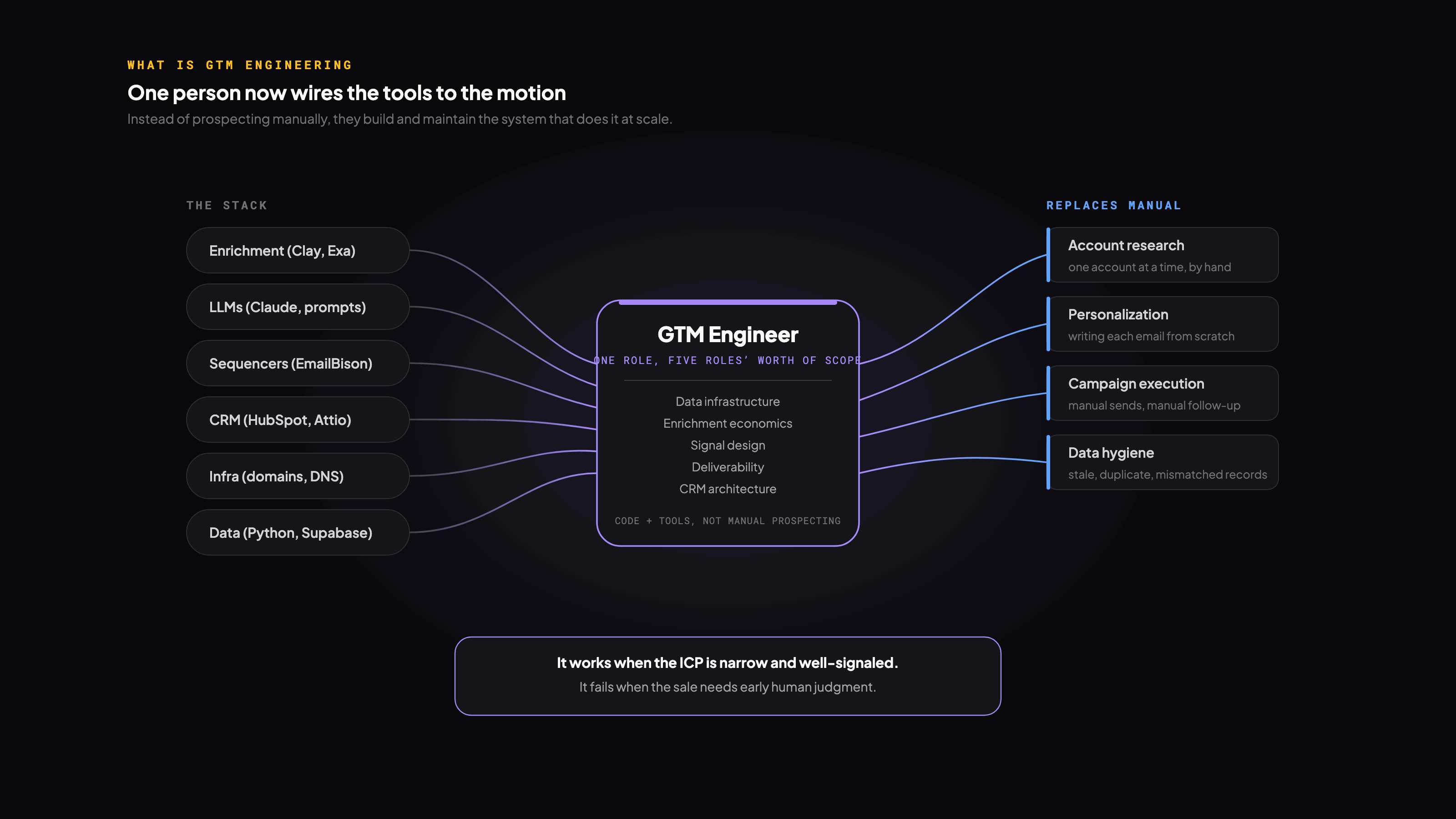
The day-to-day: infrastructure, not prospecting
- Build enrichment waterfalls in Clay: chaining providers, scoring formulas, fallback logic
- Write LLM prompts that turn account research into personalized copy
- Manage email infrastructure: domain provisioning, DNS, warmup, deliverability
- Build integrations: CRM to sequencer, enrichment platform to copy engine, reply classifier to Slack
- Analyze campaign data to find which signals, angles, and ICP segments convert
- Debug data quality: stale contacts, duplicate records, mismatched domains, failed providers
How it differs from the roles it gets confused with
| Dimension | GTM Engineer | SDR | RevOps | Growth Engineer |
|---|---|---|---|---|
| Output | Automated pipeline systems | Booked meetings | Dashboards, process | Acquisition features |
| Tools | Clay, LLMs, sequencers, scripts | LinkedIn, phone, email tool | HubSpot/Salesforce admin, BI | Product codebase, A/B testing |
| Scope | Outbound pipeline automation | Individual engagement | Cross-functional process | Product-led growth loops |
| Success metric | Pipeline per $ of infrastructure | Meetings/month | Process efficiency, data accuracy | Activation, revenue per user |
| Reports to | Head of Sales, CRO, VP Growth | SDR Manager | VP RevOps | VP Engineering/Growth |
The Stack
| Category | Common tools | Does what |
|---|---|---|
| Enrichment | Clay, Exa, Apollo, Clearbit | Account/contact data, waterfalls, scoring |
| AI/LLMs | Claude, GPT, open models via API | Research synthesis, copy, reply classification |
| Sequencing | Instantly, SmartLead, Lemlist, EmailBison | Campaign execution, A/B testing, replies |
| CRM | HubSpot, Salesforce, Attio | Contact/deal tracking, dedup |
| Infrastructure | Dynadot, ZapMail, Google Workspace | Domain registration, DNS, mailbox provisioning |
| Data | Python, Supabase, PostgreSQL | Custom enrichment, transformation, checkpointing |
Clay is the center of gravity for most GTM engineers: it connects to dozens of providers, runs AI research via Claygent, and pushes enriched contacts to sequencers by webhook. The best ones still write custom code for what Clay can't do: complex scoring, multi-step waterfalls, business-specific CRM logic.
The 'one engineer replaces five SDRs' claim, tested
It holds under specific conditions and collapses without them, which makes it a bad headline and a useful test. It works when the ICP is well-defined, signal is abundant, and technical outreach reads as credible coming from an engineer instead of a rep. It fails when the sale needs early human judgment or relationship-building that no system replicates. Replacing a team is a side effect of the right conditions being true, never a guaranteed outcome of hiring the role.
When the replacement math works
- ICP is well-defined with strong signal data
- Research and personalization, not relationship, drive initial engagement
- The product is technical enough that engineer-written outreach reads as credible
- Volume justifies building automated systems
- There's a clear handoff point to human sales
In-house hire versus agency: the real tradeoff
| Factor | Hire a GTM engineer | Hire an OaaS agency | Verdict |
|---|---|---|---|
| Timeline | Slower: hiring, ramp, then building the system | Faster: an existing team and stack start on your account | Agency wins if you need pipeline this quarter |
| Cost | One fully-loaded salary | Retainer, usually with a per-meeting component | Compare against the salary, not the invoice line |
| Best when | Outbound is a core, long-term channel | You need pipeline now while building capability | Neither is wrong, the calendar decides |
| Risk | Single point of failure if they leave | Dependency on an external partner | Both are a dependency, just on different things |
| IP ownership | Systems, prompts, data stay in-house | Varies by contract, negotiate upfront | Get this in writing before signing, not after |
The pattern we see work most often is not either/or: an agency runs outbound now while a GTM engineer hire ramps in parallel, and the transition to fully in-house happens once that hire is producing. The agency buys pipeline during the gap a new hire cannot close alone. For a full side-by-side of Astra versus hiring a GTM engineer, see the comparison playbook on this site.
What to screen for, and why one hire rarely covers it all
Technical ability without GTM judgment ships the wrong message to the right people at scale; GTM judgment without technical ability can describe the system but not build it. Screen for both: Python, APIs, LLM prompting, SQL, and Clay on the technical side, ICP targeting, reply-driving copy instincts, and data-quality judgment on the GTM side. The honest problem is that the full role spans data infrastructure, enrichment economics, signal design, deliverability, and CRM architecture, and one hire covers some of that well and the rest passably, not because they are weak but because the role is five roles wearing one title. That gap is the actual case for the fractional model: a team that already has the breadth, embedded with your ops and leadership, which is the shape we run at Astra.
How to decide
- Hire in-house when the work is steady-state, scope is understood, and you can afford to wait a quarter to start
- Go fractional when the backlog is broad, priorities are still moving, or systems need shipping before a hire could even start
- Do both when an in-house engineer is underwater and needs capacity, not a replacement
The title will keep changing; the function will not. Manual prospecting stopped being economically viable once outbound volume scaled past what a person could personalize by hand, and someone has to build and maintain what replaced it, whatever that person is called next year. Replacing a team of SDRs is a side effect of getting the system right, not the goal of building one.
Get the runnable version
Enter your email and we'll send you this playbook, plus the open GitHub repo of setup skills when it ships.
Want this built for your team?
We build and run these systems embedded with your team.